
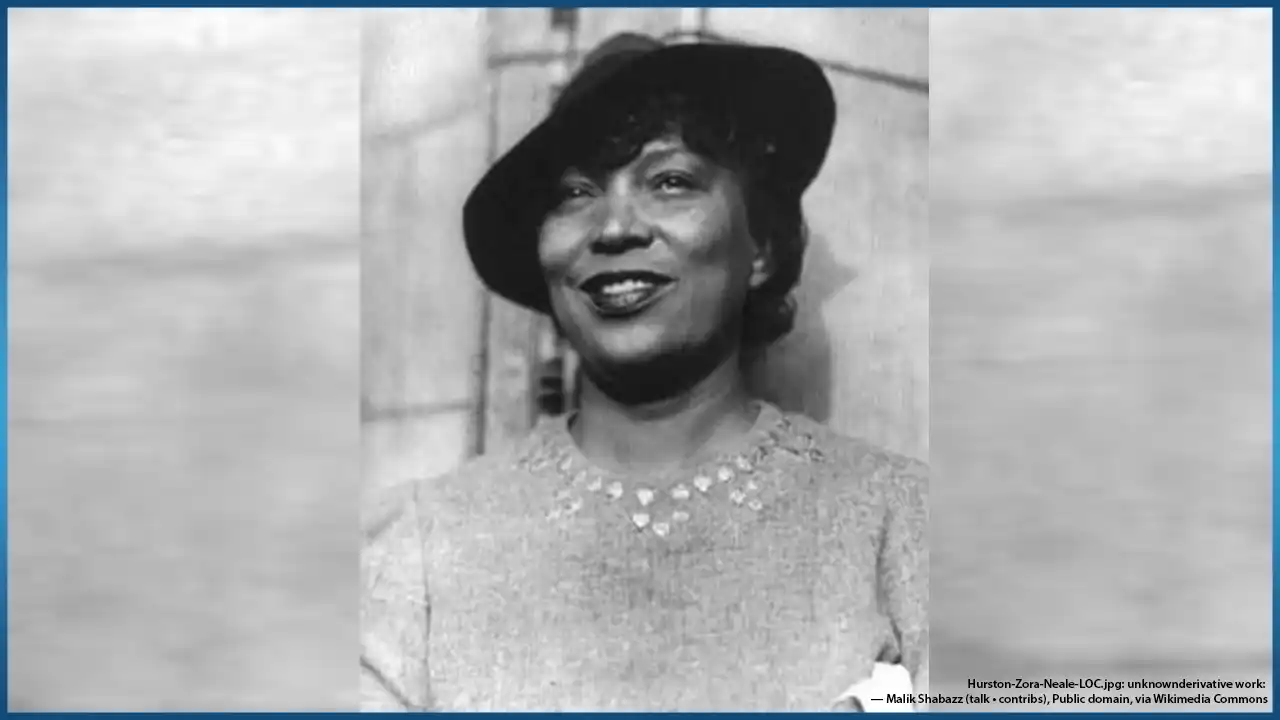


Alice Walker’s search for Zora Neale Hurston’s unmarked grave illustrates the idea of “chronic unease”—refusing to accept the quiet erasure of people’s contributions and taking action.
Alice Walker walked through waist-high weeds in a neglected Florida cemetery. She was searching for an unmarked grave.
As she walked, she called out the dead woman's name. Zora Neale Hurston.
She had talked the local townspeople into helping her find the gravesite by claiming she was Hurston's niece. One kind person accompanied her and Walker's White friend to the area where the site was located. The friend had come along because she was writing a dissertation on Hurston's life.
As Walker ploughed through the weeds, she scratched her knees and insects swarmed over her legs. The townspeople had warned her about snakes, yet she kept going with determination. She heard "things crackling and hissing in the grass."

No one knew the exact location of the grave—only that it was in a circle over an acre wide. Walker searched for a depressed area that could be the grave.
"Zora! I'm here. Are you?" she called.
At last, her foot fell into a hole and she found herself standing in "a sunken rectangle about 6 foot long and 3 foot wide."
Declaring to herself that this was the gravesite, she then went to town to buy a modest headstone. She gave the engraver the description she wanted on it:
|
|
She paid for it out of her own pocket.
I was fascinated by Walker's story about finding the grave and buying Hurston's headstone. What on earth would prompt her to go through all of that for someone she never met?
The closest I can get is her own description of her feelings at the time:
"There are times — and finding Zora Hurston's grave was one of them — when normal responses of grief, horror, and so on, do not make sense because they bear no real relation to the depth of the emotion one feels. It was impossible for me to cry when I saw the field full of weeds where Zora is."
What Walker felt wasn’t just admiration or grief; it was something hotter and harder to name.
Walker had no support from any institution. She had no grant and no assurance of finding anything. What she had was a feeling she refused to let go of: this is wrong, and I will not make peace with it.
The woman she was looking for was Zora Neale Hurston—novelist, anthropologist, architect of the Harlem Renaissance. She had died broke, and now lay buried in a segregated cemetery in an unmarked grave. Her books were out of print, and her name was fading from public memory. Not by accident. By pattern. A Black woman whose brilliance had sparked an entire era, quietly allowed to slip away.
I interviewed Mark Hays for my podcast in 2023. Mark described chronic unease not as outrage. Outrage burns bright and quick. Instead, it's a steady, low refusal to normalize what has been pushed to the margins. The term came from the safety field, where workers are taught that they have a responsibility to protect their fellow workers by pointing out unsafe conditions and not letting each other conduct unsafe acts.
Walker's pilgrimage shows what that refusal looks like.
She walked through the weeds. She claimed a sunken patch of ground as Zora's resting place. She went to a local monument maker and paid for a headstone herself. This was before she became famous as a young writer, before The Color Purple, and before winning any prizes or gaining wealth.
The stone boldly claimed, "A Genius of the South." This did more than label Hurston. It celebrated her. It re-situated her. It quietly insisted: this woman belongs in the company of the greats, whether you see it or not.
Walker decided, I will not collude with this erasure—and took it upon herself to write a different story with her own resources.
In the podcast, Mark showed me what chronic unease looks like in an ordinary professional setting.
He was at the back of a budget meeting. A young Black woman, just a month into her new role as manager, was presenting a slide deck she had clearly created herself. She was doing well. Then the questions started.
They weren't directed at her.
Every question went to her two male bosses who Mark said were "all puffed up." They confidently showed off their knowledge and took the credit. It seemed like they were unaware of what was really happening.
Mark watched from the back of the room. He and the young woman had worked together before and were pretty much synced up. They made eye contact. They both nodded at one another. She knew. He knew.
He mouthed: Do you want to do something?
She shook her head no—too risky in that setting. But she gave him a look that said: thank you for noticing. It's not just me. I'm not imagining this.
After the presentation, they talked. Together they decided to approach her two bosses privately. Mark helped her explain what happened and how to inform the bosses. This way, the bosses would know what to watch for in the future. When it was pointed out, the two men said they hadn't noticed. They were genuinely sorry and acknowledged they hadn't considered how she must have felt.
That's chronic unease doing its work. Mark and the young woman didn't confront with antagonism. Instead they allowed the two bosses to feel empathy, take responsibility, and quickly apologize to help repair the damage.
Walker's pilgrimage and Mark's meeting have the same underlying structure.
Most of us will not buy headstones for literary geniuses. Yet we all navigate spaces where some people's contributions remain unnamed and their stories go unmarked. This happens in meetings, on org charts, and in who gets credit or gets passed over.
Alice Walker's pilgrimage and Mark's intervention pose a simple and demanding question:
Where are you being asked to sustain chronic unease toward exclusion—and what is the headstone you have the power to put in place?
If you felt that familiar tightening while reading this, you're not alone. It's that moment when you see something wrong but aren't sure how to act. Or maybe you tried to help, but it didn't go well. Many people share this experience.
Chronic unease is a skill. It can be developed. That's what my work is about.
Reply, comment, or send me a direct message. Tell me a bit about your situation. We can see if a quick call would help.
→ Black women leaders: Join the free Black Women Leaders Gateway on Skool
→ Everyone else: Join the waitlist for upcoming cohorts
→ Work with Jean directly: Book a free 15-minute call
With care, Jean
¹ All quotes from Alice Walker are drawn from "In Search of Zora Neale Hurston," Ms. Magazine, March 1975. Arna Bontemps, Personals (Paul Breman, Ltd., London, 1963). Mark Hays quotes drawn from "From Hardship to Allyship: The Value of Chronic Unease," Leading Consciously podcast, Episode 21.
#ConsciousChange #BlackWomenLeaders #InclusiveLeadership #OrganizationalPowerDynamics #WorkplaceBiasAndInclusion #LeadershipIdentity #ZoraNealHurston #AliceWalker


We are a leadership development firm that helps people and organizations create resilient, sustainable, multicultural, and inclusive settings. The ability to lead consciously can help you gain true awareness and earn the respect and trust of others.
It’s the assumptions we have about people’s lives that are the biggest obstacles to growth, awareness, and success. We help you understand how those assumptions are preventing you from becoming the best you can be as an organization, an inclusive leader, and a person.

